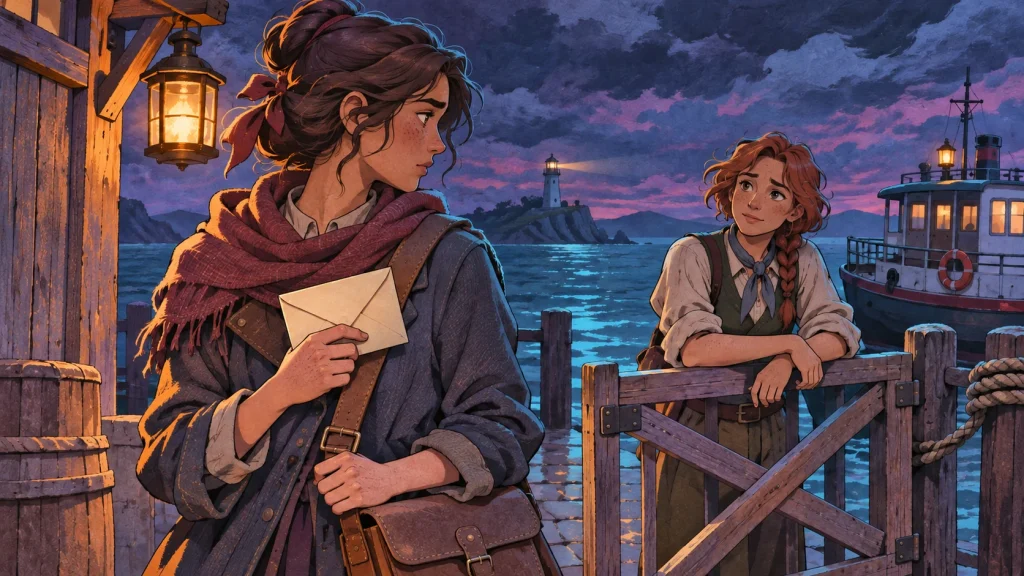

Imagine a courier arriving at the last ferry before a storm. Her friend, Mara, is waiting by the gate. Inside the courier’s bag is a letter saying that the lighthouse will close. Mara’s brother works there.
The courier could tell her now. Or she could keep the letter hidden until they reach the island.
Whichever you choose, the ferry is going to leave. Both women will be on it. The next scene will begin in the same place. But that does not mean your choice has been forgotten. There is a letter between these two friends, and what happens to it could change how they look at each other.
That is where a small interactive story can find its strength. It does not need a different ending for every answer. Sometimes it needs to remember one thing you did.
Give the reader a choice they can understand
Let’s start with the moment at the gate. Suppose the options simply say “Speak” and “Stay quiet”. You know the courier can say something, but what? A greeting? A warning about the storm? The news about the lighthouse?
It is hard to make a choice when you have to guess what the button means. Try these instead:
- Tell Mara about the closure before she boards.
- Keep the letter hidden until you reach the island.
Now you have something to think about. Mara might need time to do something about the news. The courier might worry that telling her will make her miss the ferry. You can understand both worries without the story labelling one answer kind and the other cruel.
If you are writing a scene, try explaining the choice in an ordinary sentence. Here, the reader is deciding when Mara should hear difficult news. That gives the scene much more to work with than two buttons pointing in different directions.
Let Mara answer back
Both choices can lead to the ferry, but the walk there can feel different.
If the courier tells her, Mara might step away from the gate and read the letter herself. If the courier keeps quiet, Mara might offer to carry the bag. Suddenly, an ordinary offer of help becomes awkward. The reader knows what is inside.
A later conversation can remember it too. “You should have told me sooner” lands differently from “I’m glad you let me read it.” We are still following the same journey, but the friendship has something new to deal with.
Small choices can have small answers. If you choose to make a joke, a laugh may be enough. If you promise to protect someone, you will probably expect the story to spend more time on what that promise means.
And some choices simply help you decide who the courier is. Is she frightened by the storm, or excited to get moving? Neither answer has to change the ferry’s arrival. It might change what she notices or how she speaks to Mara. That can be satisfying in its own right, as long as the story has not made it sound as though you were deciding the fate of the whole island.
The paths can meet again
Writing a separate story after every choice can soon become a lot of work. If every path splits in two at each of five choices, and none of those paths meet again, you have 32 routes through them.
You do not have to write your story that way. Our ferry can sail in both versions. When it reaches the island, the important differences are easy to name: has Mara read the letter, who is holding it, and does she know the courier kept it from her?
If you write with ink, its gathers let paths join up again after a choice. Its variables can remember details that change later lines and options. Those tools help you keep track. You still get to decide what Mara does when she learns the truth.
Start with the details you actually need. “Mara has read the letter” tells you something useful. A score saying that the courier is a good person tells you much less about this particular moment. She might have kept quiet out of kindness, fear or a wish to stay in control. Let the scene make room for that difference.
Surprise the reader fairly
A clear choice can still lead somewhere unexpected. “Ask Mara to stay” tells you what the courier will try to do. Mara is free to refuse. Her answer can surprise you without making the button misleading.
It is a different problem if you choose “Question the captain” and the courier suddenly throws the letter overboard. Unless the story has given you a good reason to expect that sort of behaviour, you may feel the game has put words—or actions—in your mouth.
Read each option together with the first line that follows it. Does the character do what the wording led you to expect? Then look at the options side by side. Sometimes you are choosing between different actions. Sometimes you are choosing how to say the same thing. Both can work, provided the reader has a fair idea of what they are choosing.
A picture can remember the choice too
In an interactive comic, Mara does not have to explain every feeling aloud. A glance, a little distance between the characters or the position of the letter can tell part of the story.
Picture the ferry pulling away. In one version of the panel, the two friends lean over the letter together. In another, they stand at opposite sides of the frame. The boat and the weather are the same. The feeling between them has changed.
Keep the important facts easy to follow, though. If the next choice depends on knowing that Mara has read the letter, make that clear in the words as well. A reader should not have to spot a tiny detail or tell two colours apart to understand what has happened.
You do not always need another drawing. Sometimes moving an object or changing one line does the job. Before adding more panels, think about what you want the reader to notice.
See what someone else makes of it
You can draw a neat map of all your choices and still be surprised by how someone reads them. Give a friend the scene without explaining what you meant it to do.
Ask what they thought each option meant, what they expected to happen and what they noticed afterwards. Their answers will tell you more than a simple “Did you like it?”
Perhaps they thought they were choosing whether to save the lighthouse, when you only meant them to choose when Mara heard the news. Have another look at the words leading up to the decision. Perhaps they understood the choice but missed Mara’s reaction. You could make that moment clearer. Or perhaps they noticed everything and wanted a bigger change; you can decide whether that belongs in the story you want to tell.
Read through every version yourself, too. Check that Mara does not mention reading a letter she has never seen. Try the scene on a narrow screen and make sure the options are easy to read and reach. A choice needs to make sense in the story and work comfortably on the page.
Try one small scene
Write two choices that lead to the same place. Let each choice get an answer straight away, then carry one detail into the next scene. It might change a line, an action or a question the reader can ask.
Keep it short enough to read both versions easily. Then take the change out and read again. Have you lost a moment of trust, an awkward silence or a piece of knowledge? If so, you have found something to build on. If very little feels different, spend a little longer on that choice before adding another branch.
A hundred endings might be right for a bigger project. For this one, it may be enough to reach the island with Mara and discover that she remembers what you did.